
What to Do After Keyword Research: Turn Your Data Into Rankings
You’ve spent hours, maybe even days, researching the perfect keywords for your site. Sounds productive, right? Here’s the thing though – most SEO strategies hit a wall right here. That keyword research can take from a few hours to a few days, yet without a well-defined plan, even the most thorough keyword research can fail to drive organic traffic, enhance online visibility, and boost conversions. The research itself won’t rank a single page.
You’ve come to the right place. Whether you’re staring at spreadsheets full of search terms wondering what comes next, or you’re tired of seeing your keyword data collect digital dust, this guide will show you exactly how to transform that research into actual rankings. From organizing keywords and mapping them to pages to conducting an analysis of keywords for search volume and competition, you’ll learn the step-by-step process that separates successful SEO campaigns from wasted effort.
It’s time to put that research to work.
Organize and Categorize Your Keywords
Raw keyword lists are basically digital paperweights until you give them structure. Trust us – organizing keywords by topic, intent, and priority will save you all sorts of headaches down the road. What looks like scattered data becomes actionable groups that align perfectly with your site architecture and content strategy.
Group Keywords by Topic and Theme
Here’s why grouping keywords into thematic categories matters: it serves two critical functions. First, it organizes your site architecture so search crawlers can accurately index your content. Second, it simplifies value assessment by allowing you to evaluate or eliminate entire keyword groups at once.
Start by identifying recurring themes across your keyword list. A local service business might separate keywords into categories like “service area pages,” “pricing and packages,” and “customer FAQs.” An ecommerce store could organize terms around “product categories,” “brand comparisons,” and “shipping and returns.” The goal is to give your keyword list a logical shape that mirrors how your customers actually think about what you offer.
Topic clusters take this organization even further. Think of them as structuring groups into interlinked content assets that reinforce topical depth. Each cluster includes a pillar page covering a broad topic and supporting pages that address specific subtopics. This layered approach increases your ranking potential across different search intents and supports visibility throughout the user journey.
Related keywords should be grouped together rather than targeted on separate pages. Terms like “how to lose weight” and “steps to shed weight” share identical intent and belong in the same thematic bucket. This prevents content cannibalization where multiple pages compete for the same rankings.
Segment by Search Intent
Tagging keywords by search intent enables effective prioritization and content matching. Four primary intent categories define what users actually want:
Informational queries seek knowledge. Users want answers, data, or details about a topic. These searches contain phrases like “how to,” “what is,” “benefits of,” or direct questions.
Navigational searches target specific brands, products, services, or organizations. Users already know their destination and use search as a shortcut to reach it.
Commercial indicates research behavior before purchase. Searchers compare options and evaluate specific parameters like sizes, colors, pricing, or “best” solutions. These queries contain terms like “versus,” “review,” “comparison,” or “top.”
Transactional keywords signal ready-to-buy behavior. Searchers know what they need and use terms like “buy,” “purchase,” “sale,” “coupon,” “discount,” or location-based modifiers.
Want to confirm intent classification? Analyze the search engine results pages. When recipe pages dominate results for “chocolate chip cookies,” the intent is clearly informational. Video tutorials ranking for “how to change your air filter” confirm educational content preference. Product pages filling results for a search term indicate transactional intent.
Keyword modifiers provide additional intent clues. “Best noise-canceling headphones” suggests comparison research, while “noise-canceling headphones review” indicates earlier-stage investigation.
Create a Keyword Priority Matrix
A priority matrix ranks keywords based on potential by mapping search volume against commercial intent. Commercial intent reflects how likely searchers are to make a purchase for that keyword.
You can determine commercial intent by examining suggested bid values in Google Keyword Planner. Higher bid amounts reveal greater advertiser willingness to pay per click, indicating higher keyword value.
Plot keywords on two axes where search volume increases as terms move from long-tail to head keywords. Priority goes to keywords with both high traffic and high intent. This creates four distinct quadrants:
Quick wins feature difficulty under 30, search volume between 100-500, and long-tail specificity. These keywords produce rankings within weeks and validate your content approaches.
Hidden gems combine low difficulty (under 30) with higher volume (500+), offering immediate traffic potential without intense competition.
Authority builders show difficulty between 30-60 with volume exceeding 1,000. These require longer content, strategic backlinks, and patience for three to six months before achieving page-one rankings.
Long shots exceed difficulty of 60 regardless of volume and demand substantial resources.
Here’s a ratio that works: target one authority builder for every five quick wins. This maintains momentum while building toward higher-value terms. Prioritize quick wins by cost-per-click, as higher CPC signals commercial value even at lower search volumes.
Map Keywords to Existing Pages

Keyword mapping assigns specific keywords to individual pages across a site. Google looks for keywords on pages to determine relevance, and ranking becomes more difficult when those terms are absent. Here’s what most people miss though: you’re probably already ranking for keywords you don’t even know about. By mapping keywords to their most relevant pages, sites can better satisfy search intent, prevent keyword cannibalization, and identify content gaps.
Audit Your Current Content
Before you start creating new pages left and right, take a step back. You need to audit existing URLs to determine what already ranks and whether those pages match user intent. This creates three distinct categories: pages to optimize, pages requiring new content creation, and content needing consolidation.
Start with a simple site search using the format site:yourdomain.com “keyword” in Google to surface all pages relevant to a particular term. When two or more URLs target the same term, they may be competing against each other rather than supporting rankings. Not the outcome you want.
Google Search Console provides performance data under the Performance tab – and it’s free, so there’s no excuse not to use it. Filter by query to view which keywords bring impressions and clicks, then examine which pages receive traffic from those terms. Multiple pages appearing for the same or closely related terms signal potential content cannibalization.
SEO tools like Ahrefs or Semrush expose overlapping URLs targeting identical terms. Look for pages ranking beyond the top five positions for the same term. When two URLs rank closely together outside the top spots, neither performs optimally. It’s like having two mediocre players instead of one strong one.
During the audit, track metrics that connect to business goals. Export landing page data from Google Analytics 4 for three-month and twelve-month periods, focusing on sessions, bounce rate, session duration, and conversions. Use site crawlers to capture page titles, meta descriptions, header structure, and page load times. Export backlink data including links per page and referring domains to identify link magnets that naturally attract high-quality links.
Pages ranking in positions four through ten often need small optimizations to push them into the top three. High-traffic pages with low conversion rates represent another opportunity. Well-performing content that could be expanded offers additional potential for growth.
Assign Primary and Secondary Keywords
For each keyword cluster, assign one primary URL along with supporting internal link URLs. Note whether the page requires creation or optimization.
Primary keywords define the main topic and should appear in the title tag and H1 heading. These keywords typically show the highest search volume within a cluster and most accurately represent page content. A service page, for example, would use its most searched and most relevant term as the primary keyword rather than a lower-volume variation. Pretty straightforward.
Secondary keywords support and expand the primary topic. These include synonyms, subtopics, and closely related phrases. If your primary term is “wedding photographer Austin,” secondary keywords like “Austin wedding photography packages” and “outdoor wedding photos Austin” provide context without diluting the primary focus.
Each secondary keyword should appear at least once in the content. Use these variations in subheadings, H2 and H3 tags, and body copy where they fit naturally. Long-tail variations work well in body content, FAQs, and supporting sections.
Assign unique keyword sets to each page to avoid cannibalization. When multiple pages compete for identical keywords, rankings suffer across all competing URLs. The exception applies to homepages, which must represent the entire site.
Optimize On-Page Elements
After assigning keywords, optimize existing pages starting with those marked “To optimize.” Content optimization typically proves faster and easier than creating new content, providing a solid foundation before expanding into new territory.
The title tag remains the most critical on-page factor, with page titles comprising approximately 13% of the ranking algorithm. Place the primary keyword near the beginning and restrict length to 60 characters. Meta descriptions should include the primary keyword and stay within 160 characters to reduce the likelihood of rewrites.
Use the primary keyword in the H1 tag exactly once per page. Include secondary keywords in H2 and H3 subheadings where appropriate. Any heading tags beyond H3 hold minimal direct SEO value.
Here’s where many get it wrong: within body content, use the primary keyword at least once near the start without appearing forced. Include it again or use contextually relevant keywords if content length allows natural flow. Secondary keywords appear throughout body copy, providing semantic richness that helps search engines understand content depth.
URLs should incorporate the most relevant keyword when pages go live. Set the URL once and avoid changes afterward. Use descriptive, keyword-rich image file names instead of generic labels. Internal links contribute to the keyword theme on pages where links occur and pass authority to linked pages.
Analysis of Keywords: Search Volume and Competition
Here’s where things get interesting. Understanding search volume and competition metrics separates keywords that drive results from those that waste resources. While keyword organization establishes structure, analysis of keywords for these two factors determines which terms deserve attention and budget allocation.
You can’t just pick keywords based on gut feeling – that’s a recipe for wasted effort.
Evaluate Search Volume Metrics
Search volume represents the average number of times people search for a specific keyword per month. But here’s what most people don’t realize: Google Keyword Planner reports this as an average of the last 12 months of search data, meaning the figure reflects total annual volume divided by 12 rather than the most recent month.
Volume numbers in Keyword Planner are broad estimates, often aggregated by combining numbers for similar keywords and rounded off. The tool also has a time lag, making it less useful for newer or trending keywords. These limitations mean the reported figures aggregate various devices and search mediums without distinguishing between mobile and desktop.
High search volume appears attractive but creates a misleading picture when viewed alone. The correlation between search volume and traffic is a myth. A page optimized for any single long-tail keyword may not drive huge traffic by itself, but when viewed collectively, multiple long-tail terms bring in substantial traffic the site might not have drawn otherwise. Lower-volume keywords often convert better since they target particular user intent rather than general information.
Our recommendation? Target keywords with at least 100 monthly searches as a baseline. Volumes below 10-20 searches per month probably won’t bring enough visitors to justify optimization efforts. However, keyword research tools typically underestimate search volume because most pages rank for multiple keywords simultaneously.
Assess Keyword Difficulty Scores
Keyword difficulty indicates how challenging it is to rank on page one for a specific term, expressed as a percentage between 1 and 100. Higher scores require more effort, time, content optimization, and backlinks to achieve top rankings.
Think of it this way – difficulty ranges provide general guidelines:
0-29 (Easy): Suitable for new websites and blogs with limited authority 30-49 (Medium): Achievable with consistent effort and some backlinks 50-69 (Hard): Requires stronger domain authority and quality content 70+ (Very Hard): Realistic only for well-established sites
Tools like Semrush provide personalized keyword difficulty (PKD) scores specific to individual domains based on authority and backlink profiles. A keyword with low PKD but higher general KD may indicate an opportunity achievable for a specific site despite appearing competitive overall.
Domain trust influences rankings significantly. High-trust websites often rank better for both competitive and low-competition keywords compared to websites with lower trust scores. Even low-trust websites can outrank high-trust ones with high-quality and current content.
Identify Low-Hanging Fruit Opportunities
Low-hanging fruit keywords are terms with lower competition but strong potential to drive organic traffic. These keywords typically feature difficulty scores of 30 or below and at least 100 monthly searches.
Google Search Console reveals striking distance keywords where pages currently rank between positions 6 and 20. Here’s why this matters: the top three organic search results receive approximately 75% of all clicks, with the first result alone capturing around 28-35% of total traffic. Pages ranking in positions four through ten need small optimizations to reach the top three spots.
As a business owner doing your own SEO, these striking distance keywords are your best immediate opportunity. Rather than chasing broad, ultra-competitive terms from the start, look for specific, lower-difficulty phrases that are closely tied to what you actually sell or offer. A plumber in Phoenix has a far better shot ranking for “emergency drain cleaning Phoenix” (difficulty 22) than “plumbing services” (difficulty 75).
Filter keywords by setting volume minimums of 100 and difficulty maximums in the easy range. Check domain authority of currently ranking sites. When low-authority sites appear in results, the keyword may be easier to rank for than the difficulty score suggests.
Balance Difficulty with Business Value
Cost-per-click offers insight into commercial value beyond search volume and difficulty. A high CPC indicates strong commercial value even when competition and search volumes appear low. Advertisers pay more for keywords that convert – revealing terms worth targeting organically.
Don’t make the mistake of evaluating metrics in isolation. A keyword with moderate volume and low difficulty might seem attractive initially. However, if it shows low CPC and doesn’t trigger useful SERP features, it may deliver less value than expected. Conversely, a keyword with slightly lower volume but high CPC, moderate difficulty, and featured snippet potential could provide more strategic value.
Balance traffic potential with ranking feasibility by targeting one authority builder for every five quick wins. This maintains momentum while building toward higher-value terms where commercial intent aligns with achievable difficulty scores.
Create New Content Based on Keyword Gaps
Content gaps represent keywords competitors rank for that a site doesn’t, along with topics absent from existing content. Here’s the thing – identifying and filling these gaps isn’t just about playing catch-up. It’s about acquiring competitor traffic, expanding visibility, and improving business results.
But let’s be honest: most people struggle with this step because they don’t know where to look or how to prioritize what they find.
Identify Missing Content Opportunities
Performing keyword gap analysis reveals terms competitors rank for in traditional search that a site lacks. Tools like Semrush’s Keyword Gap or Ahrefs Content Gap compare domain rankings against up to four competitors simultaneously. Filter results to show “missing” keywords where all competitors rank but the target site doesn’t, or “untapped” keywords where at least one competitor ranks.
The real work starts when you prioritize gaps by examining competitor top-performing keywords and checking first-page results individually. Not all gaps are created equal. Some pages show rock-solid content without gaps, while others contain holes where better content can leapfrog rankings. Common gaps include content freshness, thoroughness, usability, and uniqueness.
Don’t overlook your own underperforming pages during content audits. Pages that once received strong organic traffic but no longer perform often contain gaps compared to current top-ranking content. Review these pages as if they belonged to competitors, then improve them by shortening introductions, adding visuals, improving organization, and expanding depth. It’s often easier to fix what you have than start from scratch.
Determine Content Format and Type
Format gaps occur when audiences seek video tutorials, case studies, or interactive diagrams but only find text. Competitors serving users with varied content types create gaps that others can fill. Different formats address different user preferences and stages of the buyer journey – and that’s where opportunity lives.
How-to guides work well for informational keywords because users seeking knowledge find step-by-step tutorials valuable. Comparison pages guide potential customers deciding between options before purchase. FAQ pages answer common questions, save time, and contribute to SEO while potentially appearing in People Also Ask boxes. Product pages with detailed information drive search results and maximize customer experience for transactional keywords.
Think about the types of questions your customers ask before they buy. A landscaping company might create comparison guides for “sod vs seed installation” or how-to content for “preparing your yard for winter.” A boutique clothing retailer could develop style guides for specific occasions or tutorials for “how to measure for the right fit.” Match your content formats to what your customers are actually searching for at each stage of their decision.
Write for Search Intent
Satisfying search intent means content matches what users expect for a given term. Before creating content, clarify what users expect to accomplish on that page, then align the content strategy with that goal. Google’s results page tells you everything you need to know – analyze actual search results to confirm intent classification, as they provide clear information about user expectations.
Content structure should reflect intent from the first heading to the last word. Informational content requires definitions, benefits, and step-by-step guidance. Commercial investigation demands comparisons, pros and cons, and testimonials. Transactional content needs clear calls-to-action and straightforward next steps.
Implement Strategic Keyword Placement
Keywords should appear strategically throughout content to signal relevance to search engines and users. Place primary keywords in the title tag, H1 heading, and early in body content. Include keywords in H2 tags and throughout body copy using synonyms and related phrases.
Meta descriptions should contain keywords even though Google doesn’t use them for ranking directly, as they influence click-through rates from search results. Image alt text provides additional keyword placement opportunities while helping search engines index images properly.
Maintain keyword density around 1 to 2 percent, meaning keywords appear one to two times per 100 words. Here’s where many people mess up – keyword stuffing hurts rankings by creating unnatural content that repels readers and search engines. Focus on developing natural-sounding content that employs keywords where needed while using related terms for semantic search.
Build Authority Through Off-Page Optimization
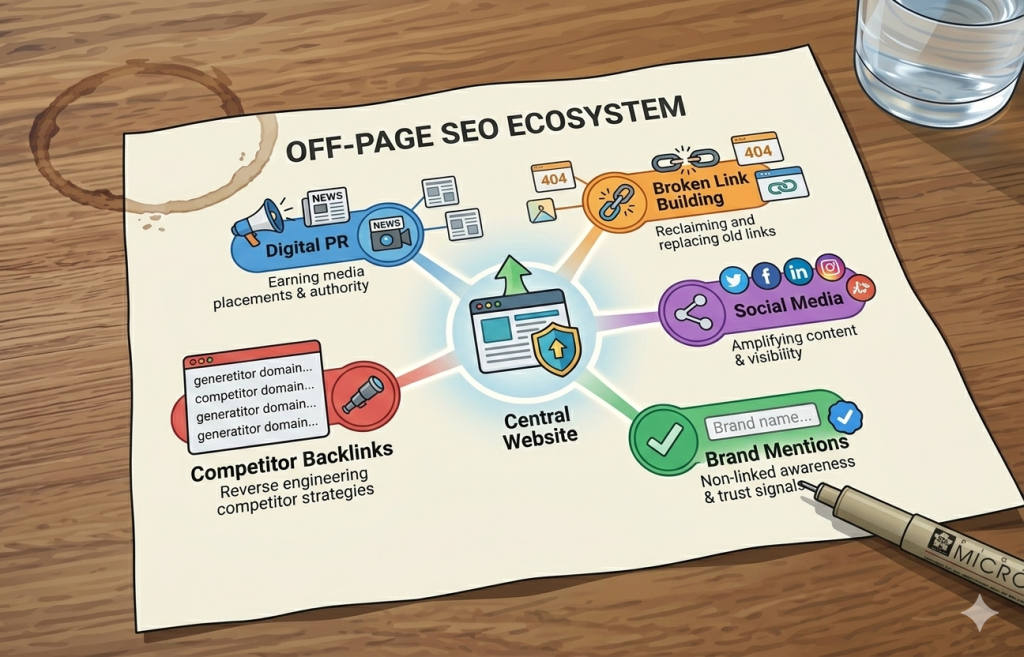
You’ve organized your keywords, mapped them to pages, filled content gaps – but here’s what most people miss: off-page optimization builds the external signals search engines use to measure site authority and trustworthiness. Link building remains a cornerstone of this process, acquiring hyperlinks from other websites that act as endorsements of content credibility and relevance.
The short answer is this, though: you can’t just create great content and expect links to appear magically. It takes strategy.
Develop a Link Building Strategy
Digital PR earns media coverage through press releases, journalist outreach, and newsworthy content, focusing on gaining backlinks and brand mentions that enhance search rankings. Creating data-driven reports, surveys, or studies provides journalists with valuable material worth citing. Trust us – journalists are always hunting for credible sources and compelling data.
Platforms like HARO connect experts with reporters looking for credible sources, earning high-authority backlinks from news sites and publications when responses provide concise, well-researched answers with expert insights. The key is being genuinely helpful, not salesy.
Broken link building finds inactive links on external sites and replaces them with relevant content. Contact site owners to suggest replacing broken links with valuable resources that seamlessly fit their existing pages. It’s not uncommon to feel hesitant about reaching out – but site owners actually appreciate when you help them fix broken user experiences.
Another tactic that works? Requesting links for unlinked brand mentions. Search for your business name online and look for mentions that don’t include a link back to your site. Reach out and request proper attribution. You’ve already earned the mention – might as well get the link that comes with it. If this process starts to feel overwhelming alongside running your actual business, working with affordable SEO services can take link building off your plate while you focus on what you do best.
Social Media Distribution
Content distribution has become far more important as audiences spread across more online spaces. AI models have fragmented search to an unprecedented level, making distribution key to meaningful SEO outcomes. Here’s something most people don’t realize: AI tools often prefer third-party sources over branded domains, which means distribution strategy needs to be broad.
Proactively distribute content on third-party sites through syndication or repurposing for platforms like Quora and LinkedIn. Social media platforms allow businesses to amplify expertise and reach decision-makers directly. Social profiles become central off-page drivers of brand awareness and traffic when campaigns gain followers.
Monitor Competitor Backlink Profiles
Want to know what your competitors are doing that you’re not? Start here.
Analyzing competitor backlink profiles helps determine whether those profiles give them ranking advantages and provides insights into their link building tactics. Compare total backlinks, referring domains, and key page metrics with competing sites to see differences in backlink profile strength.
Check which sites link to competitors but not to your domain, as these sites already cover your topic and represent practical targets for future outreach. These sites have already shown they’re willing to link to content in your space – they just haven’t discovered you yet.
Track Keyword Rankings and Performance
Here’s the truth: measurement separates speculation from certainty when determining whether optimization efforts produce rankings. You can optimize all you want, but without proper tracking, you’re essentially flying blind. Tracking tools, traffic analysis, and scheduled reviews create the feedback loop needed to refine strategies and prove ROI.
Set Up Tracking Tools
Google Search Console provides average position data calculated from actual search results rather than estimates. The platform retains data for 16 months, allowing historical trend analysis. That’s your baseline – always start here.
Ahrefs updates rankings every 24-48 hours and tracks 15 different SERP features with location-specific monitoring. Semrush’s Position Tracking tool offers Share of Voice scores to assess overall visibility. These paid tools give you the granular data you need to make informed decisions about your strategy.
Monitor Traffic and Engagement Metrics
Keyword visibility shows market share captured based on total ranking keywords. But here’s what matters more: average position proves more reliable than exact rankings due to Google’s SERP personalization across devices and locations. Don’t get caught up in whether you’re position 3 or 4 on any given day – focus on the trends.
Track macro conversions like transactions and revenue alongside micro conversions such as newsletter signups. A service business might track form fills and phone call clicks, while a product-based business monitors add-to-cart rates and checkout completions. The key is connecting your ranking improvements to actual business results – not just traffic numbers.
Adjust Strategy Based on Data
Set up daily alerts for position changes of ±5. When rankings drop, examine whether content went stale or competing results improved depth and relevance. Don’t panic at every fluctuation, but pay attention to consistent downward trends.
Strengthen pages by covering key subtopics and improving navigation. Sometimes a simple content refresh or better internal linking structure is all you need to regain lost ground.
Schedule Regular Performance Reviews
Check major keywords daily to detect sudden shifts. Review SERP features weekly to spot opportunities. Analyze historical data monthly for long-term trends. Perform quarterly competitor analysis to evaluate market position.
This might seem like a lot of monitoring, but trust us – it becomes second nature once you establish the routine. The data tells a story, and you need to be listening. If the ongoing monitoring starts taking more time than you can spare, a Shopify SEO agency or other niche specialist may be worth considering depending on your platform and industry.
Final Thoughts
Right now, you have a complete roadmap to transform keyword research into measurable rankings. The gap between data collection and actual results closes when strategies move from spreadsheets to implementation.
Whether you’re a solo business owner managing your own site or overseeing a small marketing team, these frameworks work immediately. Start with quick wins to build momentum, then target authority builders for sustained growth.
The key insight here? Keyword research delivers value only when paired with consistent action. Organize the data, map terms to pages, fill content gaps, build authority, and track performance relentlessly.
Rankings don’t appear overnight – that’s the reality. But with structured execution and regular optimization, organic visibility expands steadily. The research phase ends where implementation begins.
Trust us – it’s time to put that keyword data to work and watch your pages climb the search results.

Bryan Halverson is the owner of Proactive Online Marketing, a Fresno, CA-based SEO agency. He has 18+ years of experience in local, eCommerce, and technical SEO. Connect on LinkedIn.
- Posted by Bryan Halverson
- On March 20, 2026
- 0 Comment